YouTube Adds Automatic AI Labels
AI labels on YouTube are not new. Since 2024, the platform has asked creators to flag when they use realistic AI, the kind of content a viewer could mistake for a real person, place, or event.
For creators, that meant ticking a box in YouTube Studio, under Altered content which would generate a label under the video description…where many would never see it. YouTube’s newest update automates this process.
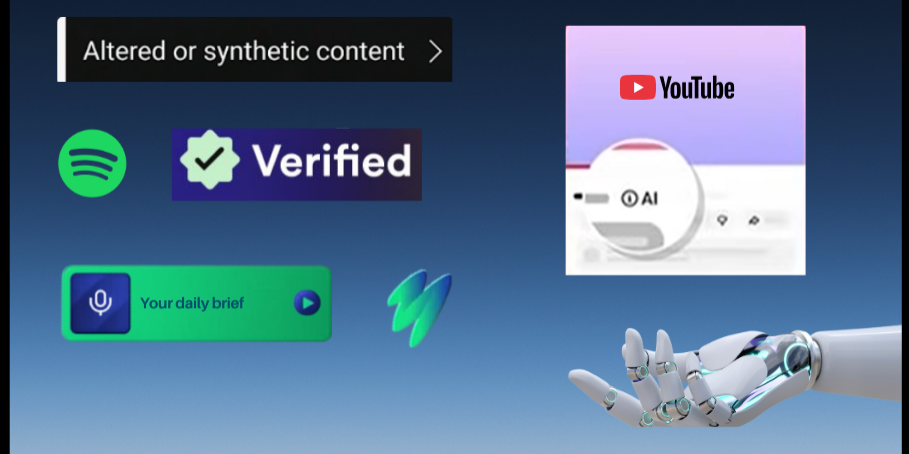
How it works: If a creator does not disclose AI but YouTube's systems detect significant photorealistic AI use, the platform now applies a label without waiting for the creator. That label is also more visible than before, sitting directly below the player on long form videos and as an overlay on Shorts. This is now the single label format for all photorealistic AI on YouTube, no longer buried in the video description, viewers see it before they press play.
Creators who think they were flagged by mistake can update the disclosure in YouTube Studio, though some labels are permanent. That includes content made with YouTube's own tools like Veo or Dream Screen, and anything carrying C2PA metadata that marks it as fully generated. One detail worth noting: the label alone does not change how a video is recommended or whether it can earn money.
So is this AI detecting AI?
Yes. Partly.
Two of YouTube's triggers are not really AI content detection at all. When a video is made with Veo or Dream Screen, YouTube already knows, because those are its own tools. When a file carries C2PA metadata, the label is part of a tag baked into the file.
The new piece is different. YouTube's AI detection tool scans a video and decides whether there is enough photorealistic AI use to warrant a disclosure label. That is AI trained to spot AI.
Detecting AI generated content is challenging, and the technology is evolving so fast that detection tools struggle to keep up. The result is that real footage gets flagged while synthetic footage slips through. And AI systems are not always reliable, even when we trust them to run on their own. In 2025, an AI coding tool wiped a production database, fabricated 4,000 users, and lied to cover its tracks.
As generative video keeps improving and the pace of change accelerates, the line YouTube is trying to police keeps moving. YouTube can detect AI, but how often will it be right, and what are the implications for creators and sponsors when it is not?
A Pattern Across Platforms
YouTube is one of many companies trying to keep ahead of AI disclosure.
Spotify is on the same path. On April 30 it rolled out a Verified by Spotify badge for musicians, a light green checkmark that signals a real human artist rather than an AI persona is behind the notes. To earn this, an artist needs the markers of an actual career, things like consistent listener activity, tour dates, merch, and linked social accounts. Profiles that look mostly AI generated are not eligible.
Then on May 19 Spotify extended the same badge to podcasts. Show pages and search results now carry the Verified by Spotify checkmark when the platform can confidently authenticate the creator behind a show. The timing is not an accident. By Podcast Index data, AI generated shows recently made up more than a third of new podcast feeds, and AI voice cloning has made it easier than ever to spin up a fake feed that sounds like a real host.
The music world has its own version of this. Spotify is rolling out an industry disclosure standard, built on DDEX that flags whether AI was involved in a track and carries that disclosure through your distributor to the listener. DistroKid is first out of the gate with a mandatory AI field at upload, and major distributors including CD Baby, Believe, and Amuse have signed on to follow. Spotify frames it as a shared supply chain standard and says the tag is there to inform listeners, not to downrank a track.
YouTube leans on detection. Spotify leans on self disclosure. Music leans on disclosure at the source. Three different methods, one shared goal: transparency.
Labeling AI While Making More of It
While platforms race to label AI, they are also generating more of it.
At its 2026 investor day, Spotify announced Personal Podcasts, an AI feature that builds spoken word audio tailored to each listener. Tell it what you care about, and it spins up a daily briefing, a deep dive, or a weekly roundup, blending general knowledge with your own listening taste and read aloud by an AI voice. There is also a companion desktop app, Studio by Spotify Labs, that pulls from your calendar, inbox, and notes to generate the same kind of personal audio.
The same company handing out badges to certify real human creators is also offering listeners a synthetic podcast made just for them. This may feel like a contradiction, but it is not. It is a snapshot of where content creation is heading, with AI content and AI labels growing side by side.
Audiences Want Disclosure
For the foreseeable future, it looks like we will be living in an in-between world with AI. Voluntary self disclosure runs alongside AI built to check for AI, which on its face sounds a little absurd. But as the technology gets better and harder to spot, knowing what is real and what is not matters more than ever.
Without this, the alternative is a feed where no one can tell what is real, and that erodes trust for everyone, listeners and advertisers included.
This lines up with where audiences already are. When Sounds Profitable asked podcast listeners how they would feel if a favorite show turned out to use AI generated voices, 47 percent said they would be less likely to keep listening, and only 21 percent said more likely. The takeaway is not that people reject AI outright. It is that they want to know when it is there. Disclosure is not the enemy of AI. It is the thing that lets AI and human work sit side by side without listeners feeling tricked.
It also fits our own stance. We have never been anti technology. We are pro clarity. Listeners and viewers deserve to know what they are looking at and who they are listening to, and the platforms are finally building the plumbing to make that possible.
Impacts for Creators Working with Sponsors
So what does all this mean for a brand and a host working together? It comes down to two things. If a brand hands a host AI generated b-roll or a synthetic product shot, and the host drops it into an episode, YouTube's detection can flag the whole video. The host carries the transparency cost for a production choice the brand made, often without knowing the footage was AI in the first place. And if that footage carries C2PA metadata, the resulting label is permanent.
Then there is the trust question. For host read endorsements, the entire value is that a real person is genuinely vouching for something. An AI badge sitting under the player may not touch your reach or your monetization, but it could quietly undercut the authenticity you are paying a premium for.
Disclosure Needs to Be the Default
This is a preview of where every platform is headed. Disclosure should be the default. Detection is becoming automatic. Verification is becoming visible. Shows built on real hosts and real conversations have an edge here, because the whole point of a host read is the connection between a person and the audience that trusts them. That is what we build.
Authenticity has always been the strongest currency in this space. Now it comes with a visible badge.
Sherry Del Rizzo
Sherry leads editorial at ADOPTER Media, translating the agency's campaign experience and podcast advertising expertise into education for the industry. Her job, in short: take what ADOPTER learns from running real campaigns and turn it into something worth reading.