CPM benchmarks refreshed July 2026, based on ADOPTER Media's campaign data from 150,000+ placed ads.
Podcast advertising rates in 2026 typically run $15 to $30 CPM for host-read mid-roll ads, which are the most common and effective placement. Pre-roll ads run $15 to $25 CPM, post-rolls at $5 to $10, programmatic and RON placements at $5 to $20, while YouTube sponsorships can command CPMs exceeding $40 for short form content where you're the sole sponsor. Actual rates will vary with the audience size, content category, and advertiser demand.
| Placement type | Typical 2026 CPM |
|---|---|
| Host-read mid-roll | $15-$30 |
| Host-read pre-roll | $15-$25 |
| Post-roll | $5-$10 |
| Programmatic / run-of-network | $5-$20 |
| YouTube simulcast | $10-$30 |
| YouTube sponsorship (short-form, 100% SOV) | $40+ |
Podcast advertising rates are the cornerstone of podcast sponsorships. The first question a podcast advertiser has is usually about podcast advertising prices: How are podcast ad costs determined? What does CPM stand for? Are dynamic podcast ad rates the same as traditional podcast sponsorships? Are host reads priced the same as pre-produced spots? What about YouTube simulcasts? Whether you're an advertiser planning a podcast ad budget or a podcaster setting your sponsorship rate card, the math works the same. This guide covers both sides of the transaction.
For a complete overview of how podcast advertising works - from ad formats and campaign planning to measuring success - check out How Podcast Advertising Works: Costs, Formats & Where to Start.
Questions? Comments? Collaborations? Reach out!
2026 Podcast Advertising Rates
Before we dig into how podcast ad pricing works, let’s take a quick look at how the landscape has evolved in 2026.
Updated CPM Benchmarks and Trends
Mid-roll host-read podcast ads now average in cost between $15 and $30 CPM, according to the latest data. This is a wider spectrum from the $15 to $25 CPM range previously thought of as the "industry standard," with niche or emerging shows sometimes priced higher or on a flat fee basis. While most podcasts still sit between $15 and $25, genres like business, health and wellness, and true crime continue to command higher rates due to curated audiences, strong listener loyalty, and advertiser demand.
Pre-roll ads remain stable at $15 to $25 CPM, while post-roll placements are still the most budget-friendly, typically ranging from $5 to $10 CPM.
Programmatic and Run of Network spots, often radio-style, typically command $5 to $20 CPMs, while YouTube simulcast CPMs can range from $10 to $30 for a spot in a long-form podcast episode to over twice the cost to be the sole sponsor in a standalone video.
CPMs May Vary
A standout trend this year is the growth of podcast integrations with platforms like YouTube. YouTube sponsorship rates have some overlap with how podcasts are priced, but short-form content (with only one sponsor) is priced differently. These campaigns often exceed $40 CPMs for US audiences, particularly when paired with high production quality, host-led storytelling, and visual brand integration. But again, note that if you pay that premium, you should be the sole advertiser and get 100% share of voice.
Long form simulcasts, which are podcasts that also have a video version on YouTube, tend to be priced more in line with standard podcast ads.
On the other end of the spectrum, programmatic audio for non host read ads can be a cost-efficient supplement with CPMs ranging from $5 to $15 depending on whether it's a run of network campaign or targeted ads. And you're often saving money going with a producer-read or radio-style, pre-produced spot since it doesn't require a host to voice or endorse.
For brands aiming to reach audiences across multiple touchpoints, these formats offer compelling ROI and a mix of broader reach. With 2026 benchmarks in mind, let’s explore how podcast advertising rates are set, what CPM really means, and the factors that influence your total cost.
How Podcast Advertising Rates Work
Podcast advertising is sold on a CPM basis, which means it’s sold by the thousands. CPM stands for “cost per mille.” (Mille means “thousand” in Latin.)
If a podcast’s CPM is $25, that means you pay $25 for every thousand listens an episode receives. (A unique download or stream counts as a “listen.”)
For example: X-Pod has 10,000 listens per episode.
Divide by 1000, then multiply the 10 by the $25 CPM.
(10,000 ÷ 1,000 = 10, × $25 = $250)
The total works out to $250 on a cost per episode basis.
The Podcast Advertising CPM Calculator
To price a podcast sponsorship opportunity, do the math and try ADOPTER Media’s CPM Calculator!
Enter your values and click “Calculate”
What's the Average Cost Per Podcast Ad?
CPM tells you the rate. It doesn't tell you what to budget. Advertisers don't spend in CPMs, they spend in dollars, so let's translate these rates into actual costs per ad.
The formula stays the same as above: take a show's average downloads per episode, divide by 1,000, and multiply by the CPM. That's the number you'll see on the insertion order.
Here's how that plays out across different audience sizes for a host-read mid-roll:
| Audience Size | Downloads per Episode | Typical CPM | Cost per Ad |
|---|---|---|---|
| Small / niche | 10,000 | $25 | ~$250 |
| Mid-size | 50,000 | $20-$30 | $1,000-$1,500 |
| Large | 250,000 | $16-$30 | $4,000-$7,500 |
| Top-tier | 1,000,000+ | Flat rate (negotiated) | $15,000-$150,000 |
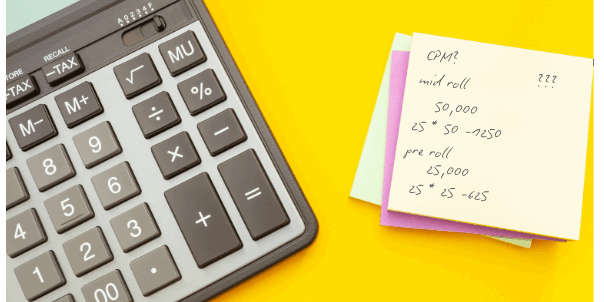
A show averaging 50,000 downloads at a $25 CPM works out to $1,250 per mid-roll. That mid-size tier is where most sponsorships actually happen, and the math scales in both directions from there.
An important thing to know about the big shows: the larger the audience, the more room there is to negotiate. Volume compresses CPMs. That's why a podcast with a million downloads per episode might charge a lower effective rate than a niche show with 10,000. (This is also why top-tier shows often skip CPM pricing entirely and quote a flat rate.)
The placement matters too. On that same 50,000-download show, a pre-roll would run a bit less than the mid-roll, a post-roll would cost a fraction of it, and a YouTube simulcast package would add video impressions on top. Same audience, different price tags.
But here's the thing about all of these numbers: they tell you what an ad costs. They don't tell you what it's worth.
Impressions and CPMs calculate cost, not value.
A $250 spot on a niche show whose audience is exactly your customer can outperform a $7,500 spot on a big show whose audience mostly isn't. Value shows up in the response, the conversions, the promo code redemptions, the search lift.
One place where cost and value start to converge is the eCPM, but more on that later.

Other Factors That Impact Podcast CPMs
Most podcasts charge a flat rate for "episodic" ad placements, rather than a varying cost based on the exact number of downloads, streams, or impressions that the episode delivers.
Podcast advertising rates are often based on the consistent average downloads/streams that each episode gets within its first 30 to 90 days. (That seems like a wide range, but it’s not. Based on our analysis of thousands of ads run in the last quarter, most podcasts hit over 80% of their downloads in the first week of release.)
In the case of the above example, X-Pod charges $250 for each episode you advertise on and they’re sure it will get at least 10,000 listens (based on its consistent listening audience).
If the episode delivers more than 10,000 listens, the sponsor gets those added impressions as a bonus. For instance, an episode’s listens can overdeliver significantly if the podcast books a big name guest. This means more exposure for the podcast advertiser at no additional cost.
(It's also why episodic buys are the best deal, especially if it's a podcast that simulcasts across audio and YouTube. Annual deals or "upfronts" also pay off as the year goes on and a podcast audience grows, plus you can sometimes negotiate a discount for buying across an entire year.)
How Dynamic Podcast Advertising Rates Work
Dynamic or “inserted” podcast ads can be a viable alternative to the usual style. With this impression-based method of serving ads, your spots are inserted into the podcast when downloaded or streamed. The dynamic element allows podcast ads to refresh over time, be geo-targeted by region, or even spread across entire podcast networks for "run of network" (RON) campaigns.
The audio is seamless to listeners - and you often can’t even tell it was inserted after the fact with host-read ads. If it’s not host-read, it’s the podcast equivalent of hearing an ad on the radio. (Podcast ads have evolved, and there are now a variety of offerings.)
Different Delivery, Same Pricing Formula
Dynamic podcast advertising rates also use a CPM to determine the cost to the sponsor. However, in this case you are paying for total listens and not per episode.
The benefits of these ads are that you can increase your exposure beyond a podcast’s new episodes. In many cases, you can insert new ads onto old episodes or across an entire network (just make sure you have an impression cap, so listeners don't hear your ads to the point it's annoying).
Using the example from above, X-Pod has 10,000 listens per episode. Let’s say its entire catalog receives 50,000 listens in a month. With dynamic advertising, you can run your podcast ads across all of them. At a $25 CPM it would cost $1,250 to sponsor the month and you'll be charged on the exact number of audio impressions served, up to that amount budgeted.

This way, each listener hears your company’s ad regardless of which episode of X-Pod they listen to during that time.
Going Granular with Programmatic Podcast Ads
Programmatic podcast ads offer a way to target audio ads at particular demographics, across specific content, or localized to defined markets. Depending on the location, demographics, content, and demand, prices may vary. Broader targets tend to cost less, niche audiences tend to cost more. As podcasting continues to grow, there are issues of scale when it comes to small markets or sponsoring individual, smaller podcasts. It's important to note, however, that these ads are rarely voiced by the podcast host. More often than not, programmatic podcast ads and streaming audio advertising resemble radio-style ad formats. As it currently stands, location-targeted podcast advertising makes sense wherever you can achieve a reasonable ad frequency.
Pro-tip: podcast advertising pixel tracking is a must for programmatic campaigns.
There Is No “Industry Standard” CPM for Podcast Ads
The podcast industry has no "industry standard" CPM. Benchmarks exist, sure, but there's often room to negotiate. Podcast advertising rates vary with each podcast, and so do the advertising formats offered.
Some podcasts offer prerolls or “top of show” ads. Others offer midroll or “mid-show” ads. A few offer postroll or “end of show” ads.
Podcasts either sell each type at a separate CPM rate, or a combination of ad placements for a single CPM. Podcast hosts deliver ads in most cases, though dynamic insertion has introduced more radio-style spots.
Demand Dictates Pricing
Depending on the podcast audience and ad format, you can expect to pay anywhere from a $5 to $50 CPM. Formats aside, advertiser demand and the quality of audience often dictates the exact amount charged and the podcast advertising cost.
For instance, a podcast covering true crime can have a very large audience with broad interests and a wide demographic. On the contrary, a podcast focused on software engineering has a narrower focus and much smaller audience. However, the engineering podcast’s listeners earn more on average. Not only that, but they’re also looking to make both personal and business purchases. Similarly, a biohacking podcast's audience is more likely to be receptive to nutritional supplements or health-related advertisers, so they can charge a premium price.
The total cost of sponsoring different podcasts might work out the same, but the more attractive audience depends on what your brand or business is looking to advertise.
And, if you're a podcaster, this is why you shouldn't just copy another show's rate card. Your audience composition is the product, and if you aren't 80% sold through on ad inventory, your listed rates is often just a starting point for negotiation.
The eCPM Often Matters More
What is an eCPM? The Effective Cost Per Mille.
eCPM shows the actual cost per thousand impressions once you factor in overdelivery. For example, if you buy an ad for 50,000 downloads at a $20 CPM, you’re paying $1,000 for that placement. That’s your CPM on paper. But if that episode overdelivers and pulls in 100,000 downloads, you still only paid $1,000—but now your effective CPM is $10, not $20, because you got twice the audience for the same price and the podcast ad metrics work in your favor.
While you won’t see that kind of overdelivery on every podcast you sponsor, some podcasts—especially those with high-profile guests or timely, news-driven content—often outperform expectations. Over the course of a year, across multiple placements, these overages can add up. In fact, it’s entirely possible for your eCPM to end up being half of what you planned for—meaning more reach, more impressions, and more value from the same budget.
Each campaign is unique, and podcast advertising budgets vary per sponsor--many also fluctuate based on the time of year. Our podcast advertising agency can get you the best podcast advertising rates to reach your target audience.
For more information, contact ADOPTER Media to start the conversation.
Podcast Advertising Rates: Common Questions
How much does podcast advertising cost?
Most host-read podcast ads cost $15 to $30 per thousand downloads in 2026. In real dollars, that means a mid-roll on a show with 50,000 downloads per episode runs $1,000 to $1,500. Smaller shows can be a few hundred dollars per episode, and the biggest shows negotiate flat rates that are often tens of thousands of dollars and can sometimes reach into the low six figures.
What is a good CPM for podcast ads?
There isn't a one-size-fits-all answer. Demand sets pricing, and $15 to $30 is simply the normal range for host-read mid-rolls right now. Paying above that range can still be a great buy if the audience is exactly your customer. Paying below it usually means you're getting announcer-read or run-of-network inventory, not an endorsement. If you can get a host-read at a deep discount, it's typically because there isn't much demand.
What should I charge for ads on my podcast?
Start with your consistent download count per episode over the first 30 days, divide by 1,000, and multiply by a CPM in the $15 to $25 range. If your audience is niche and loyal (business, health, true crime), you can justify the higher end or a flat rate above it. Underpricing is more common than overpricing, especially for shows with engaged audiences under 25,000 downloads. If your cost per episode is very low, look to sell ad packages (that can also include social media posts or newsletter mentions).
How much does it cost to advertise on a big podcast?
Top shows usually skip CPM math entirely and quote flat rates, often $15,000 to $150,000 or more per placement depending on the show. The upside: the bigger the buy, the more room there is to negotiate.
If I want to test podcast ads, can I just buy one ad?
You can, but it's like buying a single share of stock and hoping it grows into a portfolio. One bad pick and you're out entirely. And even if that one share wins big, it's a long road to the top at that pace. Host-read ads work through repetition. Listeners usually need to hear a host-read endorsement a few times before they take action. A single spot also doesn't tell you anything you can learn from: if it fails, you won't know whether the problem was the show, the episode, or the creative. Buy multiple episodes across a few shows and you're actually running a test instead of making a bet.
What's a realistic starting budget for podcast advertising?
Enough to run multiple episodes on a handful of shows. Host-read ads build response through repetition, so a single one-off spot rarely tells you anything. For most brands that means a test budget in the mid to high five figures across several shows and several weeks.
Are podcast ads cheaper than YouTube sponsorships?
On a CPM basis, usually. Host-read podcast ads run $15 to $30 CPM, while a dedicated short-form YouTube sponsorship with a US audience starts around $40. What you get for the YouTube premium is 100% share of voice and visual brand integration. Long-form simulcasts (audio and YouTube) split the difference and price closer to standard podcast ads.
Do podcast advertising rates include production?
For host-read ads, almost always. The host records the ad as part of the placement, which is a big part of why they work. Pre-produced and programmatic spots may carry separate production costs, so ask before you compare rates across formats.

Glenn Rubenstein
Glenn Rubenstein is the Founder and CEO of ADOPTER Media and author of "Podcast Advertising Works," the first book on podcast advertising. Since 2007, he's helped brands engage online audiences through authentic advertising.