Podscribe's Q1 2026 Report Highlights
Podscribe's Q1 2026 benchmark report is out. There's plenty in it for brands thinking about their 2026 mix.
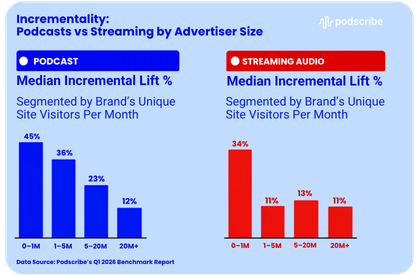
Start with the lift numbers. Smaller advertisers, the ones with under a million monthly site visitors, are pulling 45% incremental purchase lift from podcast campaigns. That's roughly twice what bigger brands are seeing, and it's well ahead of what those same smaller brands see on streaming audio, which came in at 33.8%.
It's the kind of data point worth flagging for Series B SaaS companies, DTC brands pushing past the early adopter phase, and regional players going national.
What's Driving the Data
Two things are driving it. Smaller brands are tapping into audiences that haven't been worn out by competing campaigns yet. And podcast listeners are genuinely harder to reach across other channels. About a third of weekly podcast listeners don't subscribe to pay TV, and they spend roughly 41% of their video viewing time on ad-free platforms. With fewer competing impressions getting through, each podcast exposure does more work .
Some of this is also just common sense. If a brand is new, there aren't many other places people are hearing about it, so when somebody buys, the podcast ad gets credit because it earned it. Smaller brands tend to have smaller, less diverse funnels, and that makes attribution more straightforward. Larger brands sit across retailers like Amazon and Costco and run paid search and paid social on top of that, so a single purchase has a dozen possible explanations. Podcast attribution gets buried under everything else even when the channel is working.
The Q1 dataset is based on 97,000 campaigns from over 700 advertisers and more than 30 billion impressions. Inside it, four findings stand out for how brands are spending their podcast advertising dollars in 2026.
Host-Read Holds Up
On the aggregate numbers, host-read and producer-read look surprisingly close (purchase rate 0.019% vs 0.018%, with producer-read actually edging out slightly on CPA). The more important pattern is what happens as ad load increases. At high ad loads, host-read endorsements maintain their conversion rate while producer-read spots fade noticeably. This matters right now because Q4 2025 hit 11.6% average ad load, the highest in five years of Podscribe data.
As shows increase sponsors, host-read is the format that keeps performing.
Episodic Buys Outperform Impression-Based
The conversion gap is notable (0.020% vs 0.014%) and it comes at the same CPA. The interesting part is how episodic gets there. Episodic campaigns deliver lower frequency (1.2 vs 2.1) and put far fewer impressions into the 15-plus frequency band (0.2% vs 10.6%).
Impression-based buys are over-saturating a smaller slice of the audience without proportional conversion lift. Episodic spreads the same dollars across more unique listeners who actually convert, and produces more unique ad reads in the process. That creates room to build on a core message across spots, which tends to outperform repeating the same ad word for word.
YouTube Simulcast Adoption Keeps Climbing
Adoption rose from 63% in January 2025 to 79% by December, with YouTube driving roughly two-thirds of all simulcast impressions. Podscribe is now factoring a channel's US audience share into its modeling. Channels that skew more US deliver materially better performance.
Pixels Are Still Doing the Heavy Lifting
Pixel-based attribution captured roughly six times more conversions than post-purchase surveys and nearly five times more than promo codes and vanity URLs.
About 80% of actual engagement is invisible without pixels. Brands relying on promo code redemptions alone are working with about a fifth of the picture, which leaves the channel underrepresented in their performance reports.
Patterns Worth Watching
The Q1 numbers favor smaller brands most. Their 45% lift advantage, paired with the patterns rewarding host-read formats, episodic buys, and pixel-based measurement, captures a current moment in the channel. As more challenger brands enter the space, the advantage will likely even out over time.
For bigger brands, the same stack still applies: host-read formats, episodic buys, and YouTube channels with strong US audience share, with measurement triangulated through pixel attribution. The harder work is keeping creative sharp and growth grounded in measurable performance rather than hype. The podcast sponsorship market isn't saturated. It's just being measured properly for the first time.
Podscribe Q1 2026 Performance Benchmark Report. Data covers 97,000 plus campaigns from over 700 advertisers and 30 billion impressions, January through December 2025. Get the full report here

Sherry Del Rizzo
Sherry leads editorial at ADOPTER Media, translating the agency's campaign experience and podcast advertising expertise into education for the industry. Her job, in short: take what ADOPTER learns from running real campaigns and turn it into something worth reading.