Person viewing the Q2 2026 Podscribe Performance Benchmark Report on a tablet screen.

Higher Ad Loads Can Impact Performance

Podscribe's Q2 2026 Performance Benchmark Report is packed with data on attribution, incrementality, audience buying, and YouTube performance.

One metric caught our attention: podcast ad load.

While podcast ad load dipped slightly in Q1, the longer-term trend remains elevated. And according to Podscribe's data, higher ad loads are associated with lower purchase rates.

For anyone planning a podcast advertising campaign, ad load is a metric worth paying attention to.

More Advertisers Are Investing in Podcasting
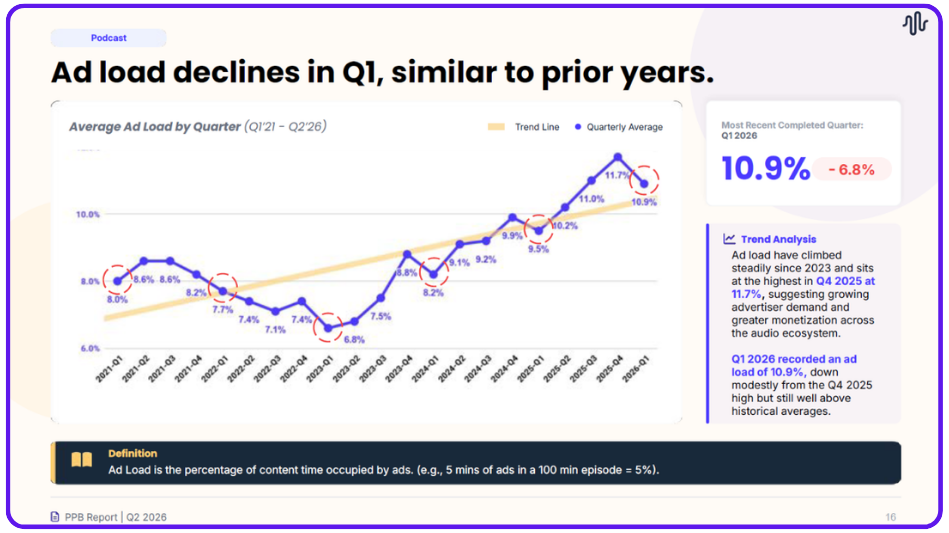
Chart showing average podcast ad load by quarter from 2021 to Q1 2026, with ad load reaching 10.9% in Q1 2026 after peaking at 11.7% in Q4 2025.
Podscribe's Q2 2026 Benchmark Report shows podcast ad load remained elevated at 10.9% in Q1 2026 despite a seasonal decline from the Q4 2025 peak of 11.7%.

According to Podscribe, average podcast ad load reached 10.9% in Q1 2026 after peaking at 11.7% in Q4 2025.

On its own, the decline might look encouraging. But Podscribe notes that Q1 slowdowns have appeared before as advertising budgets reset following the holiday season.

Viewed over a longer period, the trend shows ad load continues to climb.

After falling to roughly 6.8% in 2023, podcast ad load has climbed steadily over the past several years. Even with the Q1 decline, ad load remains well above where it stood just a few years ago.

That isn't necessarily surprising. More advertisers are investing in podcasting, networks continue to expand inventory, and the industry continues to look for ways to monetize growing audiences.

But ad load is only part of the story.

The Performance Curve Moves in the Opposite Direction

Chart showing podcast purchase rates declining as ad load increases, falling from 0.036% at 2% ad load to 0.017% at ad loads of 15% or higher.
Podscribe data suggests that as podcast ad load increases, purchase rates per impression tend to decline, indicating that more inventory does not always translate into better performance.

A few pages later, the report looks at purchase rates across different ad-load levels.

At approximately 2% ad load, the average purchase rate was 0.036%. At 8% ad load, purchase rate dropped to 0.022%. For episodes with ad loads of 15% or higher, purchase rate fell to 0.017%. Put plainly, purchase rates in the highest-load environments were less than half of what they were at the lightest.

The data shows that as ad load increases, performance per impression tends to decline.

Brands should keep in mind that more inventory creates more opportunities to buy impressions, but it doesn't necessarily create more effective impressions.

As additional advertising is added to an episode, every ad has to compete harder for listener attention. Podscribe's data suggests that competition may come at a cost.

This Isn't Just on Sellers

It's easy to view ad load as a seller issue. After all, networks and shows ultimately decide how much advertising appears in an episode. But market dynamics don't work in one direction.

Advertisers ultimately decide where to spend. If buyers continue prioritizing the lowest-cost inventory regardless of ad density, the incentives to add more inventory will continue.

That's what makes this more than a seller problem. The data suggests ad load isn't just something sellers should manage. It's something buyers should evaluate too.

Audience size, CPMs, and reach will always matter. But if listener response changes as episodes become more crowded, then the listening environment becomes part of the buying decision too.

The report doesn't suggest advertisers should avoid higher-load shows altogether. It does suggest that inventory quality extends beyond audience composition and download numbers.

Not All Impressions Are Equal

Podcast advertising works. But CPMs and reach aren't the only numbers that should shape a campaign. As ad loads rise, it's worth looking at how many other ads are running in a show before you buy it.

Source: Podscribe Performance Benchmark Report, Q2 2026.

Sherry Del Rizzo
Sherry Del Rizzo

Sherry leads editorial at ADOPTER Media, translating the agency's campaign experience and podcast advertising expertise into education for the industry. Her job, in short: take what ADOPTER learns from running real campaigns and turn it into something worth reading.


Podcast Ads. YouTube Sponsorships. Real Results.

Our agency represents advertisers to plan, manage, and optimize their host-read ad campaigns at scale.

"ADOPTER Media has been a fantastic partner for us since the earliest days of Magic Spoon."
- Gabi Lewis, Co-Founder, Magic Spoon

LATEST POSTS