Technology Should Enhance Authenticity
Over the last few years, we've shared our thoughts about AI's impact on podcasting. We called out mass-produced AI podcast slop and pushed for clear disclosure standards because audiences deserve to know when content is AI-generated. And we've been consistent about one thing: technology should enhance authenticity, not replace it.
Now the Interactive Advertising Bureau is taking those concerns and applying them to the entire ad-supported publishing ecosystem. And honestly? It's about time.
What's Actually Happening
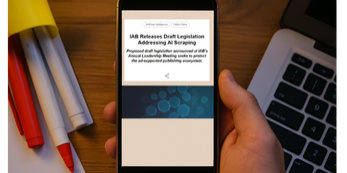
On February 2, the IAB released draft legislation called the "AI Accountability for Publishers Act." The goal is straightforward: stop AI companies from scraping publisher content to train their models and generate summaries without paying for it.
IAB President David Cohen was direct and to the point "If we continue to allow AI companies to take what they want from publishers for free, there will be few ad-supported publishers left of any kind in just a few years." The proposed legislation is built on the principle of unjust enrichment. You use someone's content? You pay for it. It's not complicated.
Why This Matters for Podcast Sponsorships
At first glance, you might think this is a traditional publisher problem. Newspapers, magazines, blogs, but not podcasts. But this affects podcast ads more than you'd think.
Podcast sponsorships work because of the trust between host and listener. That trust is built on authentic content. Content that takes time, effort, and money to create. Content that's funded by advertising.
The economic model is the same whether you're publishing articles or producing podcasts. Creators make content. Advertisers pay to reach audiences. Everyone wins when that exchange is fair.
But if AI companies can scrape transcripts, train on podcast content, and spit out summaries without compensating creators, what happens? Why would anyone invest in producing quality shows when it just becomes free training data?
We've already seen what happens when AI prioritizes volume over value. Inception Point can produce episodes for $1 each and monetize them with programmatic ads after hitting just 20 listeners.
As our CEO Glenn Rubenstein put it: "This isn't about AI helping or empowering creators, it's about flooding the market and turning AI podcasts into a paper shredder for programmatic ad dollars."
The Timeline Is Shorter Than You Think
The IAB isn't proposing this legislation because they're worried about what might happen in ten years. They're worried about what's happening right now.
Cohen draws a direct parallel to local news in the mid-2000s. Ad revenues shifted to tech platforms. Thousands of outlets closed. "News deserts" formed. And here's the part that should concern anyone working in podcast advertising: the IAB believes we're on the same trajectory, just moving faster.
"In the next few years, the ad-supported publishing industry, as we know it, will be a shell of itself," Cohen said. That's not hyperbole. That's the timeline they're working with.
Think about what that means for podcasting. Fewer quality publishers means fewer quality podcasters. Fewer authentic voices. Fewer shows worth advertising on. And eventually, fewer reasons for listeners to trust any of it.
Connecting the Dots
Our take on AI in podcasting is simple. We support tools that make podcasts better for listeners and creators alike.
That's the line. AI as a tool to enhance and innovate? Great. AI as a mechanism to strip value from creators and flood the market with cheap content? That's where we draw the line.
The IAB legislation is fighting the same battle from a different angle. They're trying to preserve the economic model that makes quality content possible in the first place.
What Happens Next
This is draft legislation. It'll need refinement, support, and political momentum to become law. But the conversation matters because it's forcing the industry to confront what's at stake.
There's also the question of enforcement. When Canada passed legislation requiring social media platforms to compensate news publishers, Meta chose to block news content entirely rather than pay. It's a reminder that tech companies don't always comply when faced with new obligations.
But the IAB's approach is different: the legislation focuses on unjust enrichment, a well-established legal principle, rather than creating entirely new regulations. That might give it more teeth. Still, the challenge remains: can publishers even block AI scrapers if they want to? The technical reality is murky, and enforcement will matter as much as the law itself.
For podcast ads, the question isn't whether AI will change the landscape. It's already changing. The question is whether that change will preserve what makes podcasting valuable (authentic voices, endorsed recommendations, real trust) or whether it'll optimize those qualities out of existence in pursuit of scale and efficiency.
We've said it before, and we'll keep saying it: authenticity isn't optional in podcast advertising. It's the entire value proposition. The IAB is fighting to protect that for publishers. We need to be paying attention because the outcome will determine what the podcast ecosystem looks like three years from now.
And three years, as it turns out, isn't very long at all.

Sherry Del Rizzo
Sherry leads editorial at ADOPTER Media, translating the agency's campaign experience and podcast advertising expertise into education for the industry. Her job, in short: take what ADOPTER learns from running real campaigns and turn it into something worth reading.